
Sherman County Projected Release Meaning
KDOC calls its predictive field the anticipated guidelines release date. It estimates the move from prison confinement into mandatory postrelease supervision for an applicable guideline sentence. It is not the historical time when staff completed a release. Related fields answer different questions: parole eligibility marks when an eligible case may be considered, conditional release is an old-law milestone, and expiration is the sentence endpoint.
A Sherman County Jail detainee awaiting trial usually has no computed sentence-release date. Bond can be posted, a judge can order release, a charge can be dismissed, or another agency can assume custody. Even a sentenced county-jail term requires the court commitment, jail credit, and the jail’s local computation. No Sherman-specific jail good-time policy or weekend-release rule was found.
Release also differs from discharge. Moving from prison to postrelease supervision ends confinement but not the sentence. An expiration or maximum-discharge record gives stronger evidence that the full corrections obligation ended.
Find Sherman County Projected Release
Choose the route by custody type. KASPER covers people and cases tied to KDOC programs. It is not a complete criminal-history file and is not the primary source for someone whose only placement was Sherman County Jail. The county jail, district court, and KDOC each hold a different part of the answer.
- Confirm the current custodian. Check the Sherman County current-inmate page for present jail custody, but do not treat disappearance from that table as proof of release.
- Read the Sherman County District Court docket for bond, sentence, jail credit, later orders, revocation, and the legal basis for custody.
- For KDOC custody, open the KASPER disclaimer and search entry. Use a KDOC number when available because names and aliases can collide.
- Compare current location, movements, anticipated guidelines release, parole eligibility, conditional release, expiration, and supervision location. Do not isolate one date from the sentence structure.
- For a county sentence, ask the jail and court for the commitment, credited jail days, existing local computation, holds, and scheduled release information.
- After the event, obtain the actual release or transfer line. The broader Sherman County released inmate search explains how the historical county record and court filing fit together.
KASPER says it updates each working day. A status may change between an update and access. Search results are also session based, so preserve the identifying facts and link to the stable entry page instead of relying on a copied result URL.
Kansas Good Time for Sherman Releases
For crimes committed on or after July 1, 1993, K.S.A. 21-6821 supplies the guideline good-time framework. The general cap is 15 percent of the prison portion. That produces the familiar shorthand that a person serves about 85 percent, but the shortcut is not a universal Kansas rule.
Specified lower-severity and offense-date groups may earn up to 20 percent. The research identifies qualifying nondrug severity levels 7 through 10 for crimes on or after January 1, 2008, certain drug severity levels 3 through 4 in the 2008 to 2012 period, and specified drug levels 3 through 5 on or after July 1, 2012. The precise offense, severity level, and offense date control.
Credits are earned. They may be withheld or forfeited, and they are not a fixed reduction announced at sentencing. Program credit and offense-specific provisions can also affect the computation. In Kansas determinate cases, earned credit often shifts time from prison into mandatory postrelease rather than erasing the whole sentence obligation.
Older crimes use a different system. K.S.A. 22-3725 sets a table-based framework for pre-July 1, 1993 cases tied to parole and conditional-release calculations. K.S.A. 22-3717 adds many offense-date and offense-specific exceptions, including rules for life and off-grid cases.
Why Sherman Release Dates Change
A forecast reflects the records and credits in force when the system calculates it. Later events can move the prison-to-supervision transition, stop physical release, or change which sentence controls. The effect is not always a later date. A corrected jail-credit entry or court order can also move a date forward.
| Factor | Possible effect | Record to verify |
|---|---|---|
| Earned or forfeited credit | Changes the computed prison portion | KDOC sentence computation and disciplinary record |
| Program credit | May alter a qualifying calculation | KDOC computation |
| Jail credit correction | Changes credited time already served | Court order and computation |
| New or corrected sentence | Can change controlling, concurrent, or consecutive terms | Journal entry and sentence structure |
| Appeal or later court order | May revise or stay the legal basis for release | District or appellate docket |
| Revocation | Can return a supervised person to custody | Court, PRB, and KDOC records |
| Detainer or hold | May turn release from one agency into transfer to another | Movement and destination fields |
A parole hearing also needs careful wording. Eligibility is only the chance for the Kansas Prisoner Review Board to consider an eligible older or off-grid case. A grant can still depend on release planning, conditions, and other legal barriers. It is not the jail gate timestamp.
Confirm Sherman County Actual Release
For a Sherman County Jail custody change, Kansas VINE can send a supported release, transfer, or escape notice. It cannot calculate a sentence and does not cover KDOC state-prison offenders. A transfer alert is not community release. Confirm the exact time, reason, authority, and destination in the sheriff’s release or movement record.
For KDOC, compare the predicted date with the later status and movement history. A community-supervision location shows release from a prison placement, while expiration or maximum discharge addresses the sentence endpoint. When the public fields do not settle the question, use the KDOC GovQA records portal to request the existing computation, movement, and discharge records.
Federal and immigration paths are separate. A BOP release date pertains to federal custody, and ICE’s locator concerns current or recent immigration custody. Neither source proves the absence of county, state, or other holds.
Sherman County Release Date Hierarchy
KDOC public records can display several dates on one person. Read them in a defined order. Anticipated guidelines release predicts a prison-to-postrelease transition. Parole eligibility identifies a possible Board-review point for a qualifying case. Conditional release is an old-law statutory milestone. Expiration or maximum discharge identifies the sentence endpoint. An actual movement date records what the agency did.
The Kansas good-time statute page shows why a single 85-percent calculation cannot replace the official Sherman County or KDOC record.
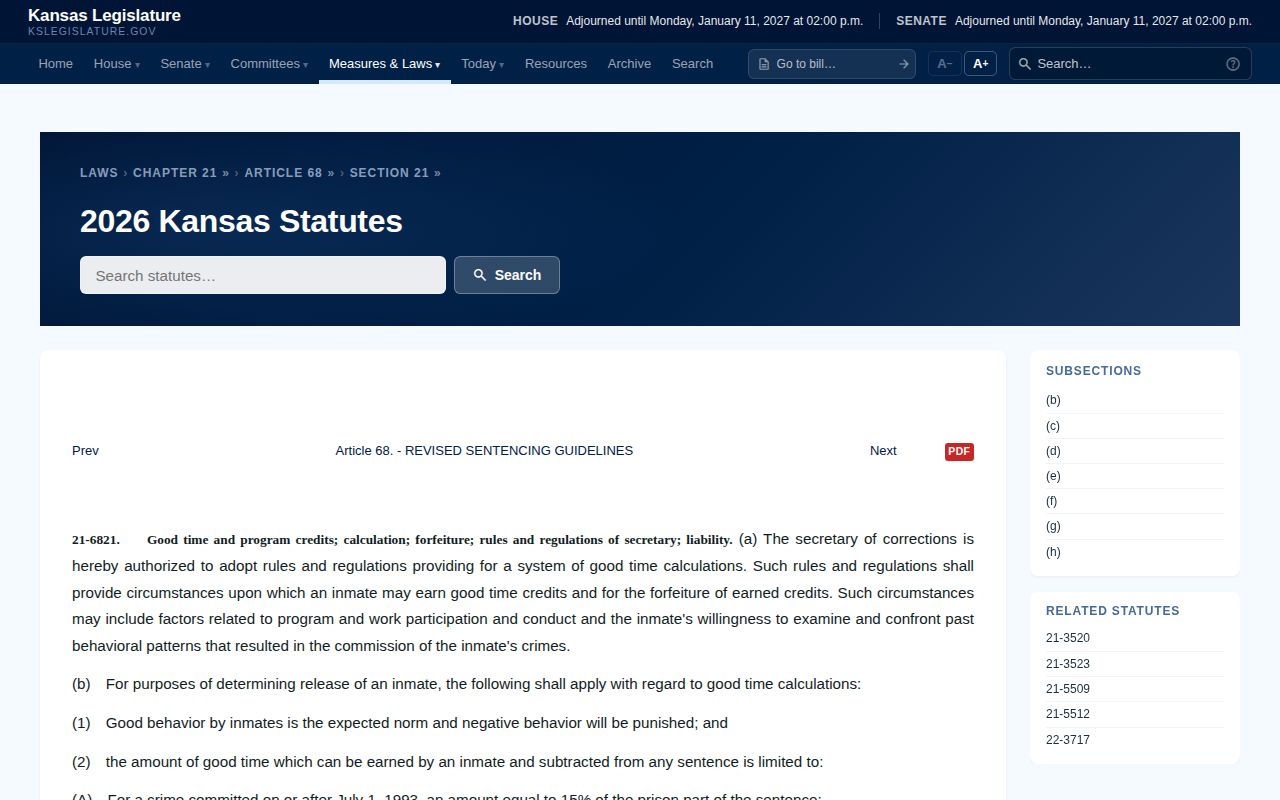
The statute’s categories and limits connect the displayed anticipated date to the governing offense and date, rather than to a generic calculator.
This hierarchy prevents two common errors. First, a parole eligibility date is not a promised release. Second, a prison exit onto postrelease supervision is not the same as expiration. When a field seems inconsistent, use the court judgment and official computation to determine which sentence and case it describes.
KASPER’s public field set also includes current location, movements and dates, parole-office location, and sentence details. A community location can explain where supervision shifted after prison, while the movement history can supply the completed act that a forecast cannot. Read the entries as one timeline. If one date belongs to a different count or sentence, the court journal entry and KDOC sentence structure should resolve the mismatch.
Some dates are absent for valid reasons. A pretrial detainee has no guideline prison computation. A county-only sentence may never enter KASPER. A federal sentence belongs in the BOP locator, while an immigration transfer belongs with ICE. A negative KASPER result therefore narrows the path but does not prove release or discharge.
Sherman County Jail Date Limits
Kansas’s state-prison percentages must not be copied onto a Sherman County Jail term. The research found no county-specific good-time ordinance, jail policy, or weekend-release statute for this facility. A reliable county calculation therefore starts with the sentencing order, jail-credit entry, any local policy the custodian actually applies, and all holds.
Ask for existing records. Useful items include the commitment, admission date, credited days, sentence-computation line, scheduled date if maintained, release authority, and destination. A pretrial case may have none of those sentence-date fields because its next event depends on the court.
Angle O is decisive here: Kansas’s common 85-percent summary is bounded, lower-severity categories can reach a 20-percent cap, pre-1993 crimes use older rules, and a county jail must use its own lawful computation. No one formula covers all four situations.
A hold adds another distinction. Sherman County can end its own custody episode while a receiving agency takes the person. The county release line should name the destination or receiving agency, and that next system then controls the next possible release date. Calling the first event “freedom” would erase the transfer.
For a past county event, ask for both movement and release tables if they are stored separately. Include the admission identifier so the answer is tied to the correct booking. A generic “not in custody” statement is weaker than the dated historical line showing the release authority and destination.
Records requests should seek facts the agency already maintains. For Sherman County, ask for the commitment, sentence calculation, actual release date and time, release reason, legal authority, and destination. For KDOC, request the sentence computation, movement history, status history, and discharge certificate when applicable. A custodian may apply lawful exemptions, but a narrow request makes it easier to identify the public portion and explain any withholding.
Timing also matters when comparing sources. KASPER reports a working-day update cycle, while a court order may post on a different schedule and a jail release can occur before either public screen changes. Record the access date, then check again or contact the responsible office. A captured forecast should never be presented as a permanent promise.
When multiple cases exist, ask which sentence controls the displayed date. Concurrent terms run together in a legally defined way, while consecutive terms can extend the total structure. The public date makes sense only when tied to the correct counts, credits, and orders.
Note: State good time, county jail credit, parole eligibility, and actual release are separate facts even when they appear near one another in a record.